
Daniel J. Ruth
Postdoctoral Researcher, Institute of Fluid Dynamics, ETH Zurich
I am a Postdoctoral Researcher in the Coletti Group, which is part of the Institute of Fluid Dynamics at ETH Zurich; beforehand I earned my Ph.D. in the Deike Lab at Princeton University.
Broadly, I am interested in multiphase turbulent flows and the experimental and numerical techniques used to study them.
Surface deformations due to turbulence
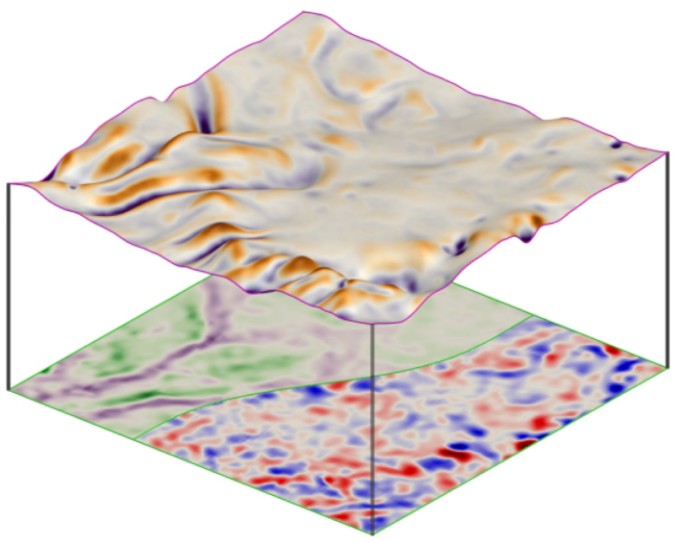
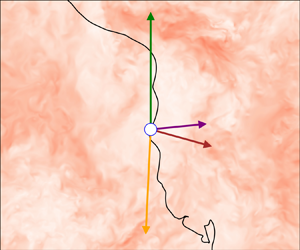
Turbulence beneath a free surface imprints itself on the surface, causing deformations related to the vorticity (left) and degree of upwelling or downwelling (right).
In this experiment, the velocity beneath the surface is measured with particle image velocimetry and the surface elevation field is measured with background-oriented schlieren. The red and blue on the left shows the surface-normal vorticity and the green and purple on the right show the horizontal divergence of velocity. The surface morphology is represented by the curved lines, which come closer to each other at surface depressions (dimples) and farther apart at bulges in the surface.
Related Publications:
Turbulence under wind-driven waves
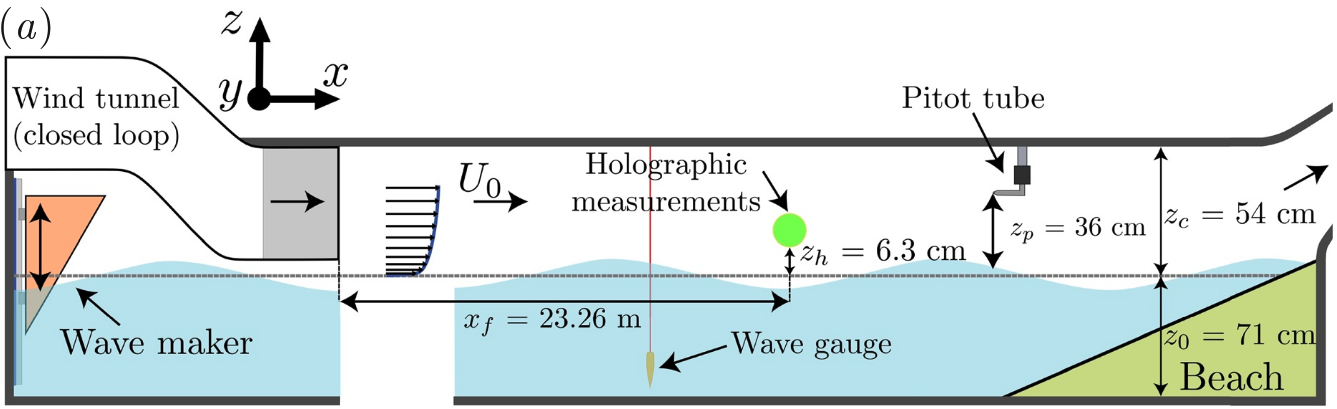
The wind-driven shear flow beneath the ocean surface is impacted by wind-generated waves which propagate overhead. I study the turbulent characteristics of these flows in the wind-water-wave flume at ETH Zurich using techniques like particle image velocimetry and laser-induced fluorescence.
The video above shows the velocity field beneath wind-driven waves, which can be decomposed into a depth-dependent mean flow, orbital motions, and turbulence.
Related Publications:
-
 Reconstructing Turbulent and Orbital Motions under Wind-Driven WavesInternational Journal of Multiphase Flow, Jun 2026
 -
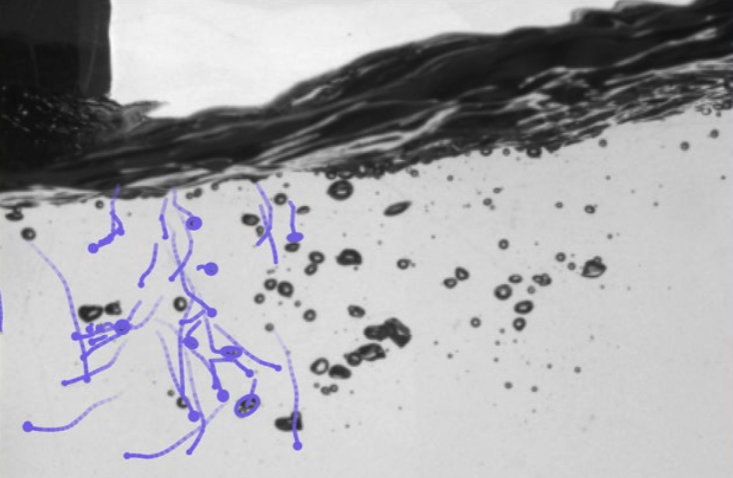 Three‐Dimensional Measurements of Air Entrainment and Enhanced Bubble Transport During Wave BreakingGeophysical Research Letters, Aug 2022
 -
 Speed and Acceleration of Droplets Generated by Breaking Wind‐Forced WavesGeophysical Research Letters, Jul 2022
Turbulence near free surfaces
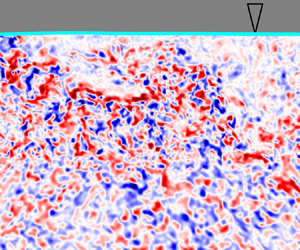
A free surface modifies the structure of a turbulent flow: vertical motions are inhibited by the presence of the surface, through which the fluid cannot pass. Further, my recent experimental work has shown that the turbulent cascade of energy is inhibited by the free surface. Approaching the surface, patches of energetic liquid are compressed vertically and extended horizontally, a “pancaking” effect which controls the inter-scale transfer of energy.
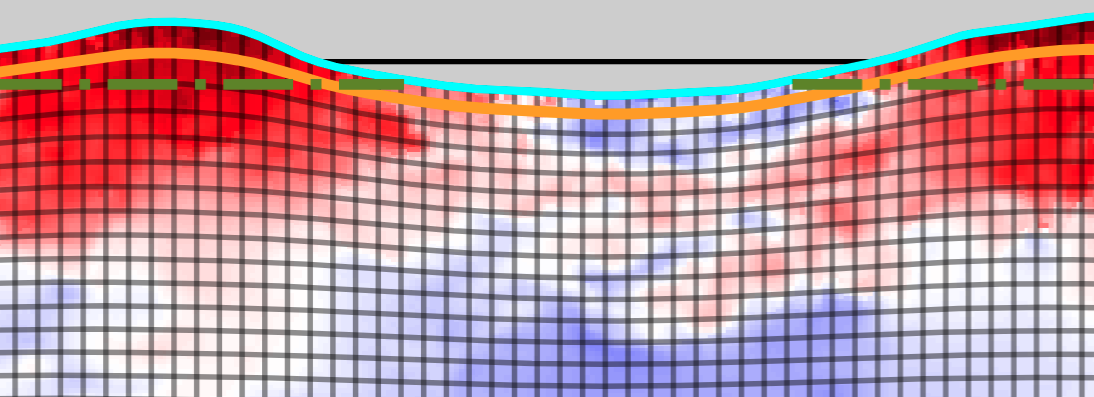
On the left in the animation above, homogeneous turbulence is generated in the bulk of a liquid by arrays of randomly-actuated synthetic jets; on the right, wind blown along the water surface in the ETH wind-wave flume induces both surface gravity waves and turbulence in the water. In both setups, particle image velocimetry is used to obtain the vorticity fields (shown in red and blue), and laser-induced fluorescence is used to locate the air-water interface (shown in cyan).
Related Publications:
Bubbles in turbulence
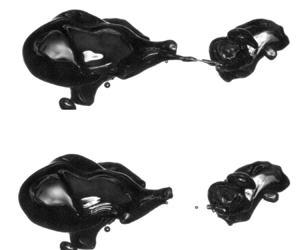
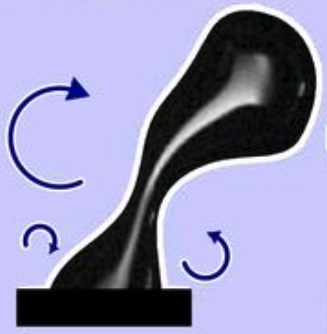
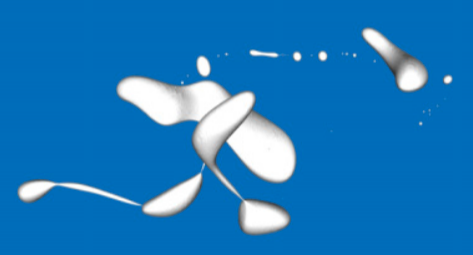
In a turbulent flow, bubbles will break apart due to stresses from the surrounding turbulent liquid if they are large enough that surface tension is incapable of preventing severe deformations. Knowledge of the dynamics of the break-ups and the distribution of bubble sizes that are produced is important to modeling bubble-mediated gas transfer, as occurs with breaking waves on the ocean and in industrial bubble column reactors.
Above, a large bubble is suddenly subjected to turbulence. The sizes of the bubbles into which it breaks are identified using high-speed imaging and particle tracking.
Related Publications:
-
 Experimental observations and modelling of sub-Hinze bubble production by turbulent bubble break-upJournal of Fluid Mechanics, Nov 2022
 -
 The effect of nonlinear drag on the rise velocity of bubbles in turbulenceJournal of Fluid Mechanics, Oct 2021
 -
-
 Capillary driven fragmentation of large gas bubbles in turbulencePhysical Review Fluids, Aug 2022